
ADHD Blog
ADHD: From "Naughty Kids" to "Not Real" and Why Everyone's Losing
Everyone is right about ADHD. And that's the problem.
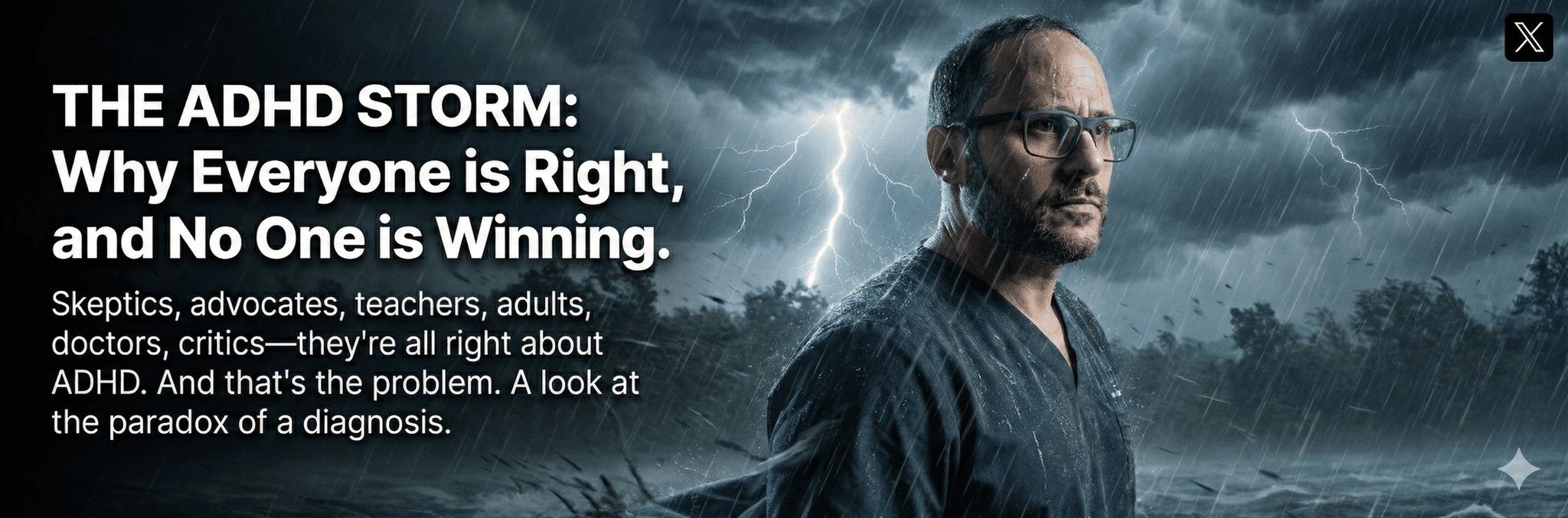
Everyone is right about ADHD. And that's the problem.
The skeptics are right: there's a flood of diagnoses that feels sudden, suspicious, almost trendy. The advocates are right: millions went undiagnosed for decades, suffering in silence. The teachers are right: something is destroying children's attention spans. The adults getting diagnosed at forty are right—this explains everything about their lives. The doctors are right: we're seeing real pathology. The critics are right: we're also seeing over-attribution.
They're all right. Simultaneously. And because no one can hold that paradox, everyone is losing.
The perfect storm
For fifty years we missed an entire generation. People who grew up called lazy, difficult, underachieving—who burned out in careers that demanded the impossible from brains wired differently. They self-medicated, self-blamed, or simply disappeared into the margins of potential unrealized. Only now are they surfacing, in their thirties, forties, fifties, finally understanding why life felt like swimming upstream while everyone else seemed to glide. Adult diagnoses have surged: an estimated 15.5 million U.S. adults (6%) are currently diagnosed, roughly half first identified in adulthood after decades of masking and self-blame. That's floodgate number one.
At the same time we've opened another: children drowning in screens, pandemic-stunted development, attention fractured by algorithmic overstimulation, diets optimized for profit rather than neurology, environmental factors that didn't exist a generation ago. They're struggling. They need help. But not all of them have ADHD. That's floodgate number two.
Caught between these two torrents are the newly diagnosed themselves—people who spent decades not knowing, now suddenly seeing ADHD everywhere in their past, their present, their every difficulty. It's overwhelming. It's clarifying. And yes, for a while it becomes an explanation for everything. This phase is real, temporary, necessary. But from the outside it looks like excuse-making.
Late-diagnosed adults surfacing en masse; over-referred children with attention problems that aren't always ADHD; newly diagnosed people in a loud, messy adjustment phase; public fatigue mounting; and institutions that cannot tell the difference between neurological difference and dysfunction. Not every attention problem is ADHD. But ADHD is far more than an attention problem. The result? No one is winning—not people with ADHD, not parents, not teachers, not employers, not society—because we're still arguing about whether ADHD is "real" instead of learning how to work with it properly.
The shifting stigma
The story of ADHD is the story of a culture that prefers moral explanations to biological ones. Each era rewrote the condition to fit its anxieties.
Then: "Naughty, lazy, badly parented kids." The problem was character. The solution was discipline.
Then: "A mental illness, a disorder." The problem was pathology. The solution was treatment, and often shame.
Then: "Skivers gaming the system for drugs and accommodations." The problem was fraud. The solution was skepticism.
Now: "Overdiagnosed, trendy, probably not even real." The problem is mass delusion. The solution is dismissal.
Notice the pattern? Each phase reduced ADHD to a moral failure. Each refused to engage with what ADHD actually is: a neurobiological difference in how the brain regulates attention, initiates tasks, processes time, and manages dopamine.
The irony is brutal. ADHD remains significantly underdiagnosed, particularly in adults, women, and high-functioning individuals. Boys are diagnosed at roughly twice the rate of girls in childhood, while women are often identified years later after inattentive symptoms are missed or misattributed to anxiety or depression. What's being overproduced isn't ADHD. It's referrals driven by overlapping symptoms in a damaged attention environment.
What people don't know (but need to)
ADHD is not an attention deficit. The name itself is a relic that's caused decades of confusion. It's a highly heritable neurobiological condition (74–80%), with consistent brain-imaging differences affecting executive control, dopamine regulation, sensory filtering, and task persistence.
- Sensory gating: The brain can't filter irrelevant stimuli. A student in a classroom hears every pencil tap, every hallway footstep, every fluorescent light hum with equal weight to the teacher's voice.
- Task initiation: Not lack of motivation, but a neurological barrier to starting things—even things you desperately want to do.
- Dopamine regulation: A reward system that makes mundane-but-necessary tasks neurologically unrewarding in ways neurotypical brains don't experience.
- Time blindness: Deadlines feel abstract until suddenly catastrophic.
The lateness, forgotten commitments, half-finished projects? Not character flaws. Side effects of a brain operating in systems designed for different wiring. When you don't understand this, you make it worse: rigid structures that punish the very differences you claim to accommodate, confusion between support and lowered expectations, and talent missed in the noise.
Why compassion alone isn't enough
The instinct is to be "nice about it"—to offer sympathy, make allowances. But people with ADHD don't need pity or lower standards. They need different structures: clear task ownership, not vague collaboration; strengths leveraged, not endless weakness remediation; varied approaches, not rigid uniformity. ADHD creates real challenges but also enables different capabilities. The question is whether we're building systems that recognize this or just managing deficits.
The missed opportunity
When skeptics dismiss ADHD as excuse-making they miss something: the same traits that derail linear work can be exceptional elsewhere. When a server crashes at 2 AM, when a client emergency erupts, when careful planning goes sideways, the person who thrives isn't usually the one with immaculate organizational systems. It's often the ADHD brain that snaps into hyperfocus, sees three solutions simultaneously, and executes under pressure that would paralyze methodical thinkers. Or pattern recognition: the colleague who can't sit through a standard meeting without drifting might be the one who spots the data anomaly everyone else missed, who connects disparate client complaints into a systemic issue, who sees the market shift before the spreadsheets confirm it.
This isn't romanticizing struggle. ADHD derails careers, strains relationships, causes real suffering. Treatment matters. Support matters. But when organizations build systems flexible enough to work with different wiring—clear ownership instead of collaborative ambiguity, varied task structures instead of one-size-fits-all processes—they don't just accommodate difference. They access capability. The question isn't whether ADHD is legitimate. It's whether we're smart enough to build systems that capture the upside instead of only managing the downside.
The real reframe
ADHD is not a behavior problem. It's not a motivation problem. It's not a character flaw. It's a mismatch between brain wiring and modern systems—systems designed for predictable attention spans, linear time perception, and dopamine responses that reward delayed gratification.
Consider the open-plan office: designed for collaboration, catastrophic for sensory gating. Or the school day: six hours of sitting still, switching subjects every forty minutes—a structure that punishes exactly the brain that needs movement to focus and depth to engage. These aren't neutral environments revealing ADHD deficits. They're specific contexts that amplify mismatch.
Yes, that mismatch creates real challenges. ADHD can derail careers, relationships, lives. Treatment matters. Support matters. Accommodation matters. But the mismatch also creates possibilities. Different wiring means different capabilities. The traits that make traditional environments difficult can make someone invaluable elsewhere. The problem isn't ADHD. The problem is that we've built a world that recognizes only one way of thinking as legitimate, then acts surprised when millions of people struggle to fit the mold.
What we owe each other
People don't need to "believe in ADHD" any more than they need to believe in left-handedness or color blindness. It exists. It's measurable. It's neurobiological. What people do need is to understand it well enough to stop making it worse, and to be smart enough to start using it properly.
That means: stop confusing accommodation with lowered expectations; stop treating every ADHD symptom as a moral failing; stop wasting time on whether it's "real" and start learning what it actually is. Start building systems that leverage different kinds of minds instead of punishing them. The data is clear: the annual global productivity loss from adult ADHD is staggering, yet the return on investment for simple accommodations can be as high as 9-to-1. This isn't charity; it's cognitive economics. Start recognizing that neurodiversity isn't a problem to solve. It's a resource we're squandering.
All of it could change if we stopped arguing about legitimacy and started building literacy. ADHD doesn't need defending. It needs literacy. Until then we'll keep mistaking noise for insight and wasting people we can't afford to lose.
Ready to explore your ADHD traits?
Take our free ASRS-based ADHD screening to get a structured view of your symptoms before you speak with a professional.